

The modern CEO role is less about “being the boss” and more about being a high-frequency decision-making engine. On a calm day, this is intellectually stimulating. But when quarterly targets are missed, a key executive quits, and a PR crisis hits simultaneously, the intellectual challenge morphs into a physiological siege.
When everything feels urgent, your brain shifts from the prefrontal cortex (logic and strategy) to the amygdala (fight or flight). In this state, your biological impulse is to react quickly rather than act correctly. You become prone to “recency bias”—overweighting the newest information—and “action bias”—doing something, anything, just to relieve the anxiety of ambiguity.
This guide is not just about frameworks; it is about cognitive survival. It outlines how to reclaim your mental bandwidth, triage the noise, and make high-quality decisions even when the building feels like it is on fire.
Why You Make Bad Calls Under Pressure
Before fixing your process, you must understand your hardware. Decision fatigue is a real psychological phenomenon. As a CEO, you have a finite amount of “decision fuel” each day. Every choice you make—from approving a budget to choosing a tie—burns a unit of this fuel.
When urgency spikes, the “cost” of each decision rises. The stress hormone cortisol floods your system, narrowing your field of vision—literally and metaphorically. You stop seeing second-order consequences (what happens after the decision) and obsess over the immediate pain.
To combat this, you must treat your attention as a protected asset, not a public utility. You cannot make strategic decisions if you are biologically depleted.
The Pause Protocol
The most effective tool for immediate urgency management is the “Pause Protocol.” When a high-stakes decision lands on your desk surrounded by panic:
- Stop the clock: Unless a server farm is physically burning down, few decisions require a response in seconds. Buy yourself time. Say, “I have received this. I will review it and get back to you by [Time].”
- Change your state: Physically move. The brain attaches stress to the physical environment. a five-minute walk resets your cortisol levels.
- Box Breathing: Use the Navy SEAL technique (inhale 4s, hold 4s, exhale 4s, hold 4s) to force your nervous system out of “fight or flight.”
Separating Noise from Signal
When everything is screaming for attention, you need a ruthlessly efficient triage system. You cannot rely on your gut, because your gut is currently panicking. You need external frameworks to sort the mess for you.
The Eisenhower Matrix
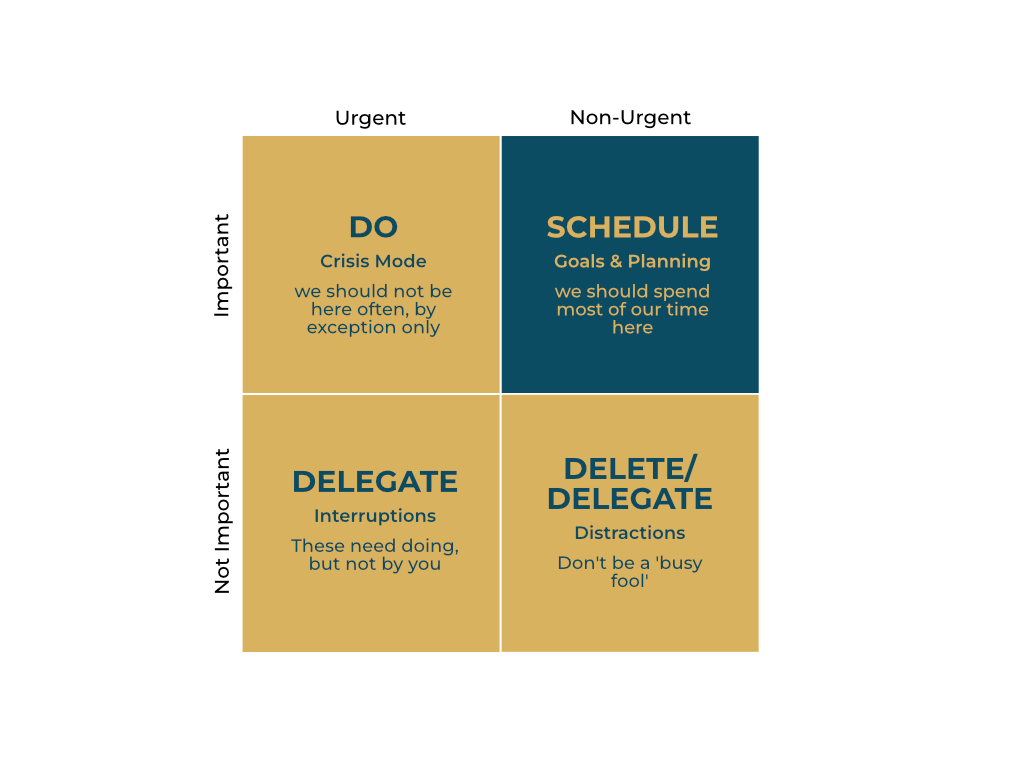
This is the classic standard for a reason, but most CEOs use it incorrectly. They focus too much on the “Urgent/Important” quadrant (Firefighting). Your goal is to live in the “Not Urgent/Important” quadrant (Strategy).
Explore
- Quadrant 1 (Do): Urgent & Important. Crises, deadlines, burning fires. These must be done by you, now.
- Quadrant 2 (Decide): Not Urgent & Important. Strategy, hiring, relationship building. This is where your business value is created. Urgency kills this quadrant first.
- Quadrant 3 (Delegate): Urgent & Not Important. Most emails, scheduling, interruptions. These are “fake work.” They feel productive but move no needles.
- Quadrant 4 (Delete): Not Urgent & Not Important. Doomscrolling, trivial analysis, busy work.
CEO Application: If you spend more than 20% of your week in Quadrant 1, your organization is broken. You are not a CEO; you are a Chief Firefighter. Use this matrix to ruthlessly push tasks into Quadrant 3 (Delegation).
Reversible vs. Irreversible Decisions (The Amazon Model)
Jeff Bezos famously distinguished between Type 1 and Type 2 decisions.
- Type 1 (One-way doors): These decisions are consequential and irreversible. If you walk through and don’t like what you see, you can’t go back. (e.g., Selling the company, a massive pivot, firing a co-founder).
- Protocol: Slow down. Gather 90% of the information. Debate vigorously. Use a committee.
- Type 2 (Two-way doors): These decisions are changeable and reversible. If you are wrong, you can just walk back through the door. (e.g., A new marketing slogan, a feature pricing test, hiring a junior contractor).
- Protocol: Move fast. Decide with 70% of the information. Delegate these whenever possible.
The Trap: When everything feels urgent, we treat Type 2 decisions like Type 1 decisions. We hold endless meetings about reversible issues, wasting cognitive fuel that should be saved for the true One-way doors.
Reducing Decision Volume
You cannot make better decisions if you are making too many decisions. A CEO making 100 decisions a day will make 90 bad ones. Your goal is to make 3 to 5 high-quality decisions a day.
Principles Over Policies
Policies are rules for specific situations (“Employees can spend $50 on dinner”). Principles are heuristics that allow others to make decisions without you (“Spend company money as if it were your own”).
When you codify your decision-making principles, you enable your team to guess your decision with high accuracy. This removes you from the bottleneck.
- Example: If a core value is “Customer Obsession over Competitor Focus,” your Product VP doesn’t need to ask you if they should copy a competitor’s feature or build a requested customer feature. The answer is embedded in the principle.
The “Who, Not How” Method
When a problem arises, the tired CEO asks, “How do I solve this?” The effective CEO asks, “Who is best equipped to solve this?”
If you are diving into the weeds to fix a sales script or debug code because it’s “urgent,” you are failing. You are solving the immediate pain but creating a long-term dependency on yourself.
- The Audit: Look at the last 10 decisions you made. How many had to be made by you? How many could have been made by a VP if they had clearer context?
Improving Decision Quality in the Moment
You have triaged the list. You have delegated the noise. Now you are staring at a massive, Type 1, urgent decision. How do you ensure you don’t mess it up?
The 70% Rule
General Colin Powell famously said that if you have 0-40% of the data, you are shooting blindly. If you wait until you have 100% of the data, you are too late. The “sweet spot” is 40-70%.
In a crisis, information is imperfect. Waiting for certainty is a decision in itself—a decision to delay, which often carries the highest cost. Get to 70% confidence, then pull the trigger.
Inversion (The Pre-Mortem)
Optimism is a CEO’s superpower, but in decision-making, it is a liability. Before finalizing a major decision, use “Inversion.”
Instead of asking, “How do we make this succeed?”, ask, “It is one year from now, and this decision was a total disaster. What went wrong?”
This forces your brain to uncover hidden risks you were ignoring.
- Did the tech stack fail?
- Did the market shift?
- Did the team burn out?
By visualizing the failure, you can build safeguards against it now.
The OODA Loop
Originally a military concept for fighter pilots, the OODA loop is critical for dynamic, high-urgency business environments.
- Observe: Gather raw data. What is actually happening? (Not what you fear is happening).
- Orient: Analyze the data in context. Filter it through your culture and strategy.
- Decide: Form a hypothesis and a plan of action.
- Act: Execute immediately.
The key is the Loop. You don’t decide once. You Act, then immediately Observe the results of that action, and cycle through again. This changes “Decision Making” from a scary cliff-edge jump into a series of rapid experiments.
The Decision Journal
One of the biggest reasons CEOs fail to improve their decision-making is that they rarely review their past performance. When the urgency fades, we forget the context of why we made a choice.
Keep a simple Decision Journal. It doesn’t need to be a novel. For any major decision, spend 5 minutes writing:
- ** The Context:** What is the situation?
- ** The Decision:** What are we doing?
- ** The Rationale:** Why did we choose this over option B?
- ** The Expected Outcome:** What do I think will happen and by when?
- ** The Emotional State:** How am I feeling? (Tired, angry, excited?)
Six months later, review this. You will be shocked. You might find that you consistently make bad hires when you are rushed, or that you are overly optimistic about sales timelines. This feedback loop is the only way to calibrate your intuition.
Lead the Urgency, Don’t Let It Lead You
Urgency is a fog. It obscures the horizon and forces you to look at your feet. Your job as CEO is to keep your eyes on the horizon, no matter how chaotic the ground is beneath you.
By protecting your biology, categorizing decisions to reduce volume, and using mental models like Inversion and the 70% Rule, you can navigate the storm.
Remember: Your team takes their cue from you. If you are frantic, they will be frantic. If you are deliberate, calm, and structured, they will be too. The most urgent thing you can do is to slow down.
If you are looking for support implementing these areas, consider CEO coaching.