

The corporate world is quietly undergoing a fundamental shift in how knowledge is created, validated, and deployed. As generative artificial intelligence models flood the internet with machine-written reports, automated market analyses, and synthetic search summaries, next-generation models are inevitably being trained on the output of their predecessors. This phenomenon—known technically as model collapse, and colloquially as AI cannibalism—creates an intellectual feedback loop where machines consume their own digital waste.
For executive leaders, this is not merely an abstract technical curiosity or a debate for computer scientists. It represents a systemic risk to enterprise decision-making, corporate governance, and operational truth. As business strategy relies increasingly on AI-filtered data, understanding how model degradation occurs—and how to insulate your organisation against it—has become an essential leadership imperative.
The Mechanics of Degradation
At its core, AI cannibalism occurs when synthetic data dominates the information ecosystem. Large language models (LLMs) operate on probabilistic pattern matching: they predict the next most likely word based on vast datasets of human expression. When those datasets consist predominantly of genuine human writing, the models capture the rich variability, nuance, and empirical grounding of real-world experience.
However, when models are trained recursively on synthetic text, a statistical smoothing effect takes hold. Tail-end probabilities—the rare insights, edge-case data points, and creative anomalies that often drive breakthrough innovation—are gradually erased. The output degrades into a homogenised median.
[Human Knowledge Base] ➔ [Synthetic Content Flood] ➔ [Recursive AI Re-training] ➔ [Model Collapse & Error Amplification]
More alarmingly, this feedback loop transforms hallucinations into accepted facts. When a first-generation AI invents a plausible but false statistic, that falsehood enters the digital public domain. As subsequent AI models scrape the web for training data, they ingest the error. What began as a statistical misfire is re-ingested, weighted, and re-issued with absolute conviction. Over multiple iterations, the hallucination undergoes a process of digital canonisation.
The Circular Citation Trap in Strategic Intelligence
For C-suite executives evaluating market entries, M&A targets, or regulatory compliance, the primary threat lies in the illusion of consensus created by circular citation.
Consider a typical scenario in modern strategic planning:
- Generation 1: A third-party vendor uses a generative tool to draft a white paper on emerging supply chain risks, unknowingly introducing a fictitious regulatory metric.
- Generation 2: Industry commentary and automated blogs summarize the white paper, repeating the metric across dozens of online channels.
- Generation 3: An enterprise-grade AI research agent, tasked by an executive team to conduct market due diligence, scrapes these disparate sources. It identifies multiple references to the metric and presents it to the Board as an established, cross-verified consensus.
By synthesising these references, the AI constructs a web of artificial validation. When every search result, automated report, and summary points back to a common, machine-generated error, traditional due diligence protocols fail. Leaders end up making high-stakes capital allocations based on synthetic consensus rather than real-world conditions.
The Risk to Executive Decision-Making
Leadership requires making high-velocity decisions under conditions of uncertainty. Historically, executives relied on human expertise, peer-reviewed research, and primary data sources to reduce this uncertainty. The proliferation of AI cannibalism threatens the integrity of these foundational inputs in three distinct ways:
- Erosion of Competitive Advantage – If an organisation relies entirely on AI tools trained on mainstream synthetic data, its strategic insights will mirror the average of the market. Unique market positions cannot be built on homogenized inputs.
- Unseen Compliance and Legal Exposure – Basing corporate governance, environmental reporting, or legal disclosures on AI-summarised intelligence carries severe liability if the underlying citations are recursively generated hallucinations.
- Degradation of Institutional Memory – As internal corporate databases adopt AI summaries to document past project outcomes, companies risk training their own internal enterprise tools on degraded, machine-written summaries rather than authentic operational learnings.
A Framework for Information Integrity
Navigating the era of AI cannibalism demands a proactive approach to information governance. Forward-thinking leaders must treat data quality with the same rigor traditionally reserved for financial auditing.
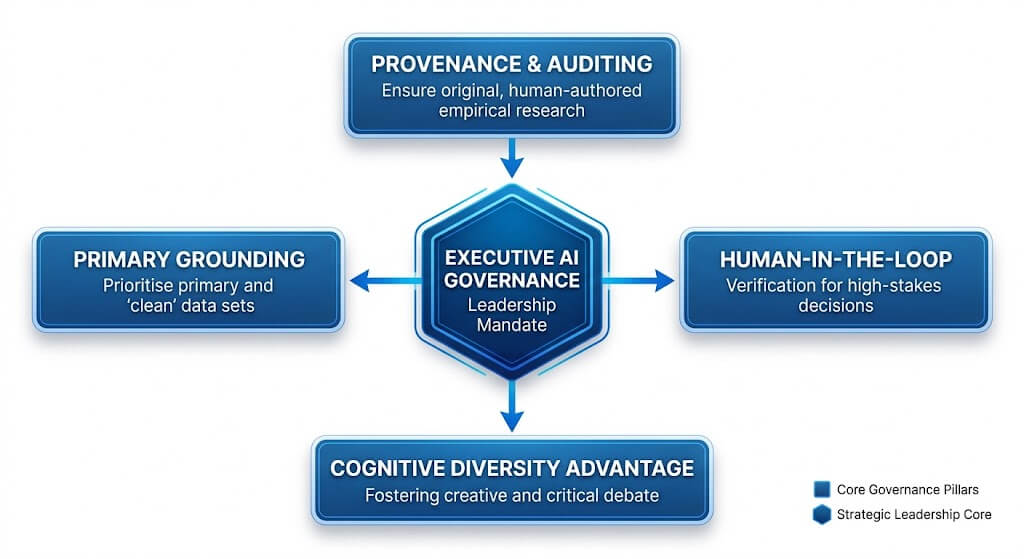
1. Enforce Strict Data Provenance and Auditing
Organisations must establish clear protocols for data provenance. When accepting strategic reports, market intelligence, or risk assessments—whether from internal teams or external management consultancies—executives should demand primary-source attribution. AI-generated summaries must be traceable back to original, human-authored empirical research.
2. Prioritise Primary and “Clean” Data Sets
In the age of synthetic pollution, proprietary, first-party data becomes an organisation’s most valuable intellectual property. Leaders must invest heavily in capturing, clean-structuring, and protecting authentic operational data. Internal AI models should be fine-tuned predominantly on verified enterprise records rather than open-web scraping.
3. Maintain “Human-in-the-Loop” Verification for High-Stakes Decisions
While AI can accelerate research and synthesis, critical strategic decisions must retain mandatory human verification checkpoints. Subject-matter experts must audit the foundational assumptions of any AI-assisted analysis before board-level execution.
4. Cognitive Diversity as a Strategic Countermeasure
Models trained on synthetic data trend toward mediocrity and consensus. To counter this, leadership must actively nurture human creativity, critical debate, and counter-intuitive thinking within their management teams. The ability to challenge algorithmic output will become a key differentiator for high-performing boards.
Preserving the Value of Human Judgment
AI cannibalism is not an insurmountable barrier to adoption, but it is a sobering reminder of the limitations of machine intelligence. As the digital landscape becomes increasingly saturated with synthetic noise, the premium on genuine human insight, empirical verification, and intellectual rigor will rise exponentially.
For executive leaders, the mandate is clear: build systems that leverage the speed of artificial intelligence without sacrificing the integrity of human truth. The organisations that thrive in this next era will not be those that automate thoughtlessly, but those that govern their information ecosystems with uncompromising standards of accuracy.